Showing posts with label About UAE. Show all posts

What is The local currency in Dubai ?

Friday, September 24, 2010


Dubai Local Currency


The local currency in Dubai is the UAE Dirham (Dhs) which is divided into 100 fils. The currency is also referred to as AED (Arab Emirate Dirham).
Exchange rates of all major currencies are published daily in the local newspapers.
Money Exchanges
Money exchanges are available all over Dubai, offering good service and reasonable exchange rates, which are often better than the banks. Additionally, hotels will usually exchange money and travellers cheques at the standard hotel rate.
Credit Cards
Most shops, hotels and restaurants accept the major credit cards (American Express, Diners Club, MasterCard, Visa). Smaller retailers are sometimes less keen to accept credit cards and you may have to pay an extra five percent for processing.
Banks & ATM's
Banks offer the full range of commercial and personal banking services.
Generally banking hours are from Saturday to Thursday 8am – 2pm. Closed on Friday. However, more and more banks are extending their opening hours.
Most banks operate ATMs, also known as Cash Points or Service Tills, which accept a wide range of cards. Common systems accepted around Dubai - American Express, Cirrus, Global Access, MasterCard, Plus System and VISA. ATMs can be found in all shopping malls, at the airport, at petrol stations and at various street-side locations.
Most international banks have branches in Dubai, servicing the usual retail and corporate segments. Transfers can be made easily as exchange controls are virtually non-existent, and the Dirham is freely convertible.

Read more »

Information about Dubai's Climate

Thursday, September 23, 2010


Dubai's Climate


The city of Dubai is situated on a coastal strip bordered by a desert and gets very hot and humid in the summer. Cooler, more pleasant weather lasts from the end of September to beginning of May. From May to September the sun is intense and temperatures can touch 50 degree Celsius in the city and even higher in the desert! Due to the scorching heat coupled with a humidity of 80-90% near the coast, you have to refrain from daytime outdoor activities during summer.
Temperatures range from a low of about 10 degrees Celsius on winter nights, to a high of 48 degrees Celsius in the midday summer heat.
The months of January and February generally produce the highest rainfall, if any. Usually it amounts to about 13 centimeters, spread over five days per year.
Due to weather changes around the world, in recent years the winter months in Dubai have seen quite unpredictable weather. Believe it or not, Dubai sometimes gets bouts of heavy rain that leaves streets, roads, and sometimes homes flooded. Of course this is almost always followed by the usual sunshine. Occasionally, heavy winds stir up sandstorms that make driving conditions difficult since visibility on the roads is severely reduced.
It’s important to know exactly what to expect of the climate in Dubai whether you’re here for leisure, business, or to stay. With this information in hand, you’ll be ready no matter what nature has in store.
Average Monthly Climate Chart


Read more »

The UAE Vice President launches Dubai Metro

Wednesday, September 22, 2010


UAE Vice President launches Dubai Metro

Dubai: It’s your city. And it’s your Metro now. Fireworks lit up the night sky, motorists honked their horns and scores of onlookers cheered as the first train rolled out of the station, past the towering skyline along Shaikh Zayed Road, opening a new chapter in Dubai’s history.
Dubai became the first Gulf state to have a metro and joined the league of megacities around the world that have similar transport systems.
His Highness Shaikh Mohammad Bin Rashid Al Maktoum, Vice-President and Prime Minister of the UAE and Ruler of Dubai, bought the first ticket on the Dubai Metro, after which the first train left Mall of the Emirates station: 09/09/09 will remain etched on a board at the station.
"I thank everyone from the bottom of my heart for this great job. If it weren’t for this collective effort we would not have achieved this. My message to the world is that life is all about challenges and the people of the UAE, under the leadership of President His Highness Shaikh Khalifa Bin Zayed Al Nahyan, love challenges and we are up to them," Shaikh Mohammad said.
"I congratulate Shaikh Khalifa and the people of the UAE on this huge achievement. This is an achievement for all Arabs," he said.

Motorists drove slowly on Shaikh Zayed Road, following the first train out of the station, and some even parked underneath bridges to catch their first glimpse of the blue streak as it emerged on its maiden voyage to Al Rashidiya Station.
The Metro is part of Shaikh Mohammad’s vision to develop an integrated transport system including the Metro, bus network, marine transport and an advanced road infrastructure.
The world’s longest automated driverless train system, which cost Dh28 billion, has been launched in a record time of four years. It will carry 1.8 million passengers per day by 2020, according to RTA estimates.

Read more »

Sheikh Zayed bin Sultan Al Nahyan was the president of the UAE

Friday, September 10, 2010

Sheikh Zayed bin Sultan Al Nahyan, Founder of the UAE

 
His Highness Sheikh Zayed bin Sultan Al Nahyan served as President of the United Arab Emirates since the formation of the Federation on 2 December 1971 and as Ruler of the Emirate of Abu Dhabi since 1966.
Understanding the UAE is impossible without understanding the life of Sheikh Zayed and his deep religious faith, his vision, his determination and hard work, his generosity at home and abroad, and the way in which he devoted his life to the service of his people and the creation of a better world.
Born around 1918 in Abu Dhabi, Sheikh Zayed was the youngest of the four sons of Sheikh Sultan bin Zayed Al Nahyan, Ruler of Abu Dhabi from 1922 to 1926. At the time Sheikh Zayed was born, the emirate was poor and undeveloped, with an economy based primarily on fishing and pearl diving and on simple agriculture in scattered oases inland.
Life, even for members of the ruling family, was simple. Education was generally confined to lessons in reading and writing, along with instruction in Islam from the local preacher. Transport was by camel or boat, and the harshness of the arid climate meant that survival itself was often a major concern.
Through the late 1920s and 1930s, Sheikh Zayed’s thirst for knowledge took him into the desert with Bedouin tribesmen to learn all he could about the way of life of the people and the environment. He later recalled with pleasure his experience of desert life and his initiation into the sport of falconry, which became a lifelong passion.
In 1946, Sheikh Zayed became Ruler’s Representative in the Eastern Region of Abu Dhabi, centered on the oasis of Al Ain. The job involved administering six villages and an adjacent desert region. In the late 1940s and early 1950s, Sheikh Zayed established his clear vision of what he wished to achieve for the people of Al Ain, and as someone who led by example.
Despite few government revenues, Sheikh Zayed succeeded in bringing progress to Al Ain, establishing basic administration, personally funding the first modern school in the emirate and coaxing relatives and friends to contribute towards small-scale development.
He revised local water ownership rights to ensure a more equitable distribution, which led to agricultural development and re-establishment of the oasis as the predominant market center. His city planning in Al Ain helped ensure that today, the city is one of the greenest in Arabia.
In August 1966, Sheikh Zayed became Ruler of Abu Dhabi, with a mandate to develop the emirate as quickly as possible. His years in Al Ain had given him valuable experience in government and time to develop a vision of progress. With the export of the first cargo of Abu Dhabi crude in 1962, he could rely on oil revenues in the service of the people, and a massive construction program for schools, housing, hospitals and roads was underway.
In 1968 the British announced their intention of withdrawing from the Arabian Gulf by the end of 1971. Sheikh Zayed, with the late Ruler of Dubai, Sheikh Rashid bin Saeed Al Maktoum, took the lead in calling for a federation that would include not only the seven emirates that made up the Trucial States, but also Qatar and Bahrain.
Eventually seven states followed Sheikh Zayed in establishing the UAE, which formally emerged on the international stage on December 2, 1971. While his enthusiasm for federation was a key factor in the formation of the UAE, Sheikh Zayed also won support for the way in which he sought consensus and agreement among his fellow rulers.
Sheikh Zayed was elected by his fellow rulers as the first President of the UAE, a post to which he was successively re-elected at five-year intervals.
One foundation of his philosophy as a leader and statesman was that the resources of the country should be fully used to the benefit of the people, including the women of the UAE who benefited of his vision of education, employment and equality.
In governing the nation, Sheikh Zayed drew from Arabian Bedouin traditions of consensus and consultation. At an informal level, that principle has long been practiced through the institution of the majlis (council) where a leading member of society holds an “open-house” discussion forum, at which any individual may put forward views for discussion and consideration.
In 1970, recognizing that Abu Dhabi was embarking on a process of rapid development, Sheikh Zayed formalized the consultation process and established the National Consultative Council, bringing together the leaders of each of the main tribes. A similar body was created in 1971 for the entire UAE: the Federal National Council, the state’s parliament.
The conservation of natural environment and wildlife was critical to Sheikh Zayed. He believed that the character of the Emirati people derives, in part, from the struggle to survive in the harsh and arid local environment and worked throughout his life on preserving such species as the Arabian Oryx and the sand gazelle. The World Wildlife Fund recognized his contribution with the prestigious Gold Panda award.
Sheikh Zayed was a firm opponent of harsh dogmas and intolerance. In an interview in 2002, he said, “Muslims stand against any person of Muslim faith who will try to commit any terror act against a fellow human being. A terrorist is an enemy of Islam and of humanity, while the true Muslim is friendly to all human beings and a brother to other Muslims and non-Muslims alike. This is because Islam is a religion of mercy and tolerance.”
Sheikh Zayed applied his ideals of consensus and tolerance more broadly. Within the Arabian Gulf region, and in the broader Arab world, the UAE has sought to enhance cooperation and to resolve disagreement through a calm pursuit of dialogue and consensus.
In the 1990s he also recognized that the UAE could play a more active role in international peacekeeping operations. The UAE Armed Forces participated in the Arab Deterrent Force that sought to bring to an end the civil strife in Lebanon, and in UNISOM TWO, the United Nations peacekeeping and reconstruction force in Somalia.
In early 1999, Sheikh Zayed was among the first world leaders to express support for the decision by the North Atlantic Treaty Organization (NATO) to launch its aerial campaign to force Serbia to halt its genocidal activities against the people of Kosovo. From late 1999 to 2001, the UAE contingent serving with the UN’s KFOR peacekeeping force was the largest from any of the non-NATO states, and the only one from an Arab or Muslim country.
While ensuring that the UAE should increasingly shoulder international responsibilities, however, Sheikh Zayed also made it clear that the UAE’s role is one that is focused on relief and rehabilitation.
In the Balkans, Iraq, Afghanistan and other countries, the policy adopted by the UAE clearly reflects the desire of Sheikh Zayed to apply the good fortune of his country to those less fortunate. Through bodies like the Zayed Charitable and Humanitarian Foundation and the Abu Dhabi Fund for Development, established by Sheikh Zayed before the foundation of the UAE, as well as through institutions like the Red Crescent Society, the country now plays a major role in the provision of relief and development assistance worldwide.
Sheikh Zayed died in 2004, in his late eighties.
Read more »

Introducing The United Arab Emirates ( UAE )


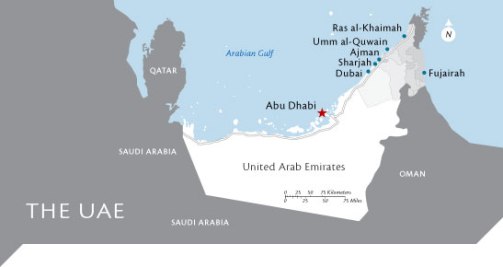
The United Arab Emirates consists of seven independent city-states:

Abu Dhabi, Dubai, Sharjah, Umm al-Qaiwain, Fujairah, Ajman and Ra’s al-Khaimah. Four-fifths of the UAE is desert but has contrasting landscapes—from the towering red dunes of the Liwa to the rich palm-filled oases of Al Ain, from the precipitous Hajar Mountains to the more fertile stretches of its coastal plains.
Though small in size (similar to the State of Maine), the UAE has become an important player in regional and international affairs.
In 1971, the late President His Highness Sheikh Zayed bin Sultan Al Nahyan unified the small, underdeveloped states into a federation—the only one in the Arab world. With his visionary leadership, oil wealth was used to develop the UAE into one of the world’s most open and successful economies.
In 2004, His Highness Sheikh Khalifa bin Zayed Al Nahyan became president and has since continued to strive towards an ambitious vision for the UAE.

Globalized and Open


In just over three decades, the nation has transformed from a tribal culture reliant on agriculture and fishing to an entrepreneurial success story with world-class infrastructure. The leadership has improved education (effectively eliminating illiteracy), advanced health care and embraced change as the UAE modernizes, consistent with its history and cultural values.
The UAE is also strengthening institutions of government to ensure a transparent legal system with full regard for the quality of life of all citizens and residents. Four members of the Federal Cabinet are women.
The UAE is a member of the United Nations, the World Trade Organization, the Arab League and the Gulf Cooperation Council.
Today the UAE is a strong, vibrant and modern nation that is open to the world.

Read more »

The Real History About The United Arab Emirates ( UAE )

Wednesday, September 8, 2010

History of UAE

The UAE’s rich history is rooted in trade and tied to Islam, which came to the region in AD 630. Its location between Europe and the Far East attracted merchants from India and China and was prized by Europeans, in particular the Portuguese, the Dutch and the British.

While Europeans sought control of the coasts, inland, the ancestors of the Bedouin made the sandy deserts of Abu Dhabi and Dubai their home. The town of Abu Dhabi became an important center.

In the 19th century, the British signed a series of agreements with the individual emirates that resulted in the area becoming known as “The Trucial States.” They agreed not to dispose of any territory except to the United Kingdom and not to enter into relationships with any foreign government other than the United Kingdom without its consent. In return, the British promised to protect the coast from all aggression by sea and to help in case of land attack.

The pearling industry thrived in 19th and early 20th centuries, providing income and employment to the people of the Gulf. Many inhabitants were semi-nomadic, pearling in the summer and tending date gardens in the winter. But the economic depression in the late 1920s and early 1930s, coupled with the Japanese invention of the cultured pearl, irreparably damaged the industry.
New Beginnings

In the early 1930s the first oil company teams conducted geological surveys. In 1962, the first cargo of crude was exported from Abu Dhabi. With oil revenues growing year by year, HH Sheikh Zayed bin Sultan Al Nahyan was chosen as Ruler of Abu Dhabi in 1966. He undertook a massive program of construction of schools, housing, hospitals and roads.

One of Sheikh Zayed’s early steps was to increase contributions to the Trucial States Development Fund. Abu Dhabi soon became its largest donor. In the meantime, HH Sheikh Rashid bin Saeed Al Maktoum, de facto Ruler of Dubai since 1939, developed shipping to replace pearling revenues. When Dubai’s oil exports started in 1969, Sheikh Rashid was able to use oil revenues to improve the quality of life of his people.

At the beginning of 1968, when the British announced their intention to withdraw from the Arabian Gulf, Sheikh Zayed acted rapidly to establish closer ties with the emirates. With Sheikh Rashid, Sheikh Zayed called for a federation that would include not only the seven Emirates that together made up the Trucial States, but also Qatar and Bahrain.

Agreement was reached between the rulers of six of the Emirates (Abu Dhabi, Dubai, Sharjah, Umm al-Qaiwain, Fujairah and Ajman), and the Federation to be known as the United Arab Emirates was formally established on 2 December 1971. The seventh Emirate, Ra’s al-Khaimah, acceded to the new Federation the following year.

Since then, the seven Emirates have forged a distinct national identity. The UAE’s political system combines traditional and modern and enabled the country to develop a modern administrative structure while ensuring that traditions of the past are maintained, adapted and preserved.

Read more »

The Government of The United Arab Emirates ( UAE )


UAE Government

Under the UAE system of government, the President of the Federation is elected by a body known as the Supreme Council of Rulers. The Supreme Council is the top policy-making body in the UAE, and the President and Vice President are both elected from its membership for renewable five-year terms.
The Supreme Council has both legislative and executive powers. In addition to planning and ratifying federal laws, the Supreme Council approves the President’s nominated Prime Minister and is equipped to accept his resignation, if required.
The Prime Minister is appointed by the President. He or she then appoints a Council of Ministers, or Cabinet, to oversee the development and implementation of federal policy across all portfolios of government.
In addition to the Supreme Council and the Council of Ministers, a 40-member parliament known as the Federal National Council (FNC) also examines proposed new legislation and provides advice to the UAE Cabinet, as required. The FNC is empowered to call and question Ministers in regard to their own performance, providing an additional degree of accountability to the system. Groundbreaking developments to open up decisionmaking were made in December 2006, with the first indirect election of FNC members. Previously, all FNC members were appointed by the Rulers of each Emirate.
The introduction of indirect elections represents the beginning of a process to modernize the UAE’s system of government. Under these reforms, individual Rulers select an electoral college whose members total 100 times the number of FNC members held by that Emirate. The members of each college then elect half of the FNC members, while the other half continue to be appointed by each Ruler.
The process resulted in an FNC in which one-fifth of its members are women.
Future initiatives are expected to expand the size of the FNC and strengthen the interaction between it and the Council of Ministers, to further improve the efficiency, accountability and participatory nature of government in the UAE. In November 2008, the terms for FNC members were extended from two to four years, which is more consistent with other parliaments in the world. In addition, the government will report to the FNC about proposed international treaties and agreements, and those agreements will be discussed by the FNC before their ratification.
Historically, the political environment of the UAE has been characterized by great affection for the country’s leadership and institutions of government. This is largely in response to the rapid growth and development the UAE has experienced under their guidance in recent decades.
YOU MAY VISIT THE UAE Government  HERE
Read more »


Copyright © 2010 Dubai Beauty
Using XclearTheme | Bloggerized by Themescook